
A TOUCHSTONE REVIEW:
The Chakras * by Charles Webster Leadbeater Quest Books; 2nd edition (2013)
* For this review, I have mined information on the history and influence of this book from Kurt Leland’s Rainbow Body: A History of the Western Chakra System from Blavatsky to Brennan (2016).
The Author (1854-1934)
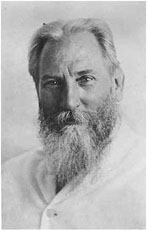
Charles Leadbeater in 1914 (age 60)
The young Charles Webster Leadbeater, interested in spiritualism and trained as an Anglican clergyman, joined the Theosophical Society in 1883 and became a high-ranking officer of the Society. He remained one of its leading members until his death in 1934, writing over 60 books and pamphlets and maintaining regular speaking engagements. At the time Leadbeater wrote The Chakras, he was a bishop of the Liberal Catholic Church (a reinvention of Catholicism along Theosophical lines).
Leadbeater’s first substantial reference to the chakras occurred in 1898 in answer to a question concerning the existence of organs in the astral body. Leadbeater’s clairvoyant investigations of the chakras seem to have occurred at about the same time.
According to his memoir, Leadbeater developed clairvoyant abilities in 1885 at Adyar, India, then the location of the headquarters of the Theosophical Society. Leadbeater reported that this instruction required “a year of the hardest work I have ever known.” He claimed to have been visited by one of the Theosophical Masters, who suggested he practice a certain type of meditation connected with developing the kundalini power. This training the Master said he would oversee himself, and made Leadbeater pledge never to divulge it to anyone else except with his authorization. Leadbeater was further instructed by a physically embodied Hindu yogi, Subba Row, whom Blavatsky claimed had the same Master (Morya) as she did.
In Leadbeater’s perception, the five lower chakras grow out from the spinal ganglia on stems toward the front of the body in flower-like funnels that open into circular vortexes. Details of Leadbeater’s clairvoyant investigations appear in the chapters “Force-Centers” and “Serpent Fire.”
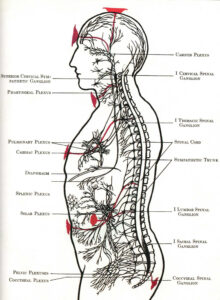
Leadbeater’s Chakras—Side View (reprinted from C. W. Leadbeater’s The Chakras, 1927) Note the “stems” attaching the chakras to the spine and the vortices or “flowers” showing at the front of the body.
During his investigations, Leadbeater reported seeing saucer-like depressions on the surface of the etheric body, vortices either sluggish or in rapid rotation, glowing and pulsating with living light, with petals like spokes resulting from wavelike undulations that were formed as forces rushed around in the vortex, producing a shimmering, iridescent effect like mother-of-pearl, yet with each chakra having its own predominant color (two inches across and dull in color when undeveloped and four to six inches across and flashing like miniature suns when developed), bringing Divine Life into the physical body. He also saw a protective web between each chakra of the ethereal body and its astral counterpart. The nacreous silvery aspect of these undulations or petals, he says, is likened in Sanskrit works to “the gleam of moonlight on water.”
“If we imagine ourselves to be looking straight down into the bell of a flower of the convolvus type,” he says, “we shall get some idea of the general appearance of a chakra.”
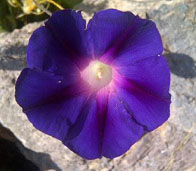
The Morning Glory, a member of the plant family Convolaceae.
The Book
First published in 1927, this pioneering book by clairvoyant C. W. Leadbeater was among the first to introduce to the West the concept of chakras and the seven chakra system as centers of spiritual contact in the human body and bridges to higher consciousness and well-being. He didn’t ask, Are chakras real? And he didn’t seek scientific evidence. He based his findings on his own mystical experience of the chakras described in the ancient texts of Hinduism. At that time, he was a pioneer in the field of subtle energies, and the first to publish a clairvoyant view of the chakras and their energy flow.
KEY IDEAS IN THE CHAKRAS
The principal points of the process are presented below in sequence.
The Force Centers
Leadbeater begins by identifying the chakras as force centers and describing their appearance according to his own experience.
The Forces
Before going on to describe how the force centers are awakened, Leadbeater discourses on the origin and nature of “the mysterious power called kundalini or the serpent fire,” the three nadis or channels through which the three streams of energy flow in and around the spinal cord, the movement of forces through the nerve systems, and the “vital energy” or “prana” carried in sunlight.
The Absorption of Vitality
Leadbeater devotes an entire chapter to explain in greater detail how vital energy or prana, in the form of “vitality globules,” is absorbed as food by the etheric double. “Etheric” being the name Leadbeater gives to a type of matter that is “still physical though invisible.”
The Development of the Chakras
Without giving away precise details of the practice, which is only handed down orally from teacher to student, Leadbeater discusses the way to properly awaken the energy centers, and how and why to avoid premature awakening.
The Laya Yoga
The final chapter of the book, written twenty years later than the material preceding it, discusses the English translations of Sanskrit literature which existed at the time that dealt with laya yoga, a practice in which Supreme Consciousness is achieved and the self is united with the Divine by working energy down from the crown chakra through the lower chakras to awaken kundalini.
Leadbeater’s Chakra System Explained
In the Eastern chakra system, the energy that awakens the chakras either arises from the lowest chakra at the base of the spine or descends from the highest at the top of the head or circulates in both directions, but always along the spine.
In Leadbeater’s system, these vortices form along the outer edge of the astral and etheric bodies. They absorb forces from their respective planes and channel them into the core of the body along whirling funnels (a lesser known meaning of chakra is “whirlpool”) that converge on astral or etheric centers that correlate to organs or nerve plexuses of the physical body.
Leadbeater’s model arranges the subtle bodies in layers around the physical body like nested dolls increasing in size. In the same way, each organ and nerve center is surrounded by its own etheric field, a more expansive astral field, and an even more expansive mental field.
According to Leadbeater, astral energy entering the vortex of each astral chakra carries information, which the astral center registers in accord with that center’s function. Astral energy and information may then pass through the etheric equivalent of the astral center and thence to the associated physical organ or nerve plexus.
In his model, undeveloped chakras have no stems or funnels and no flower-like openings to the outer edge of a subtle body. Developed chakras have these structures, which Leadbeater calls the “sense organs” of the etheric, astral, and mental bodies. The chakras of the etheric body “bring down into physical consciousness” the characteristics of their associated astral centers, thus making them “gates of connection between the physical and astral bodies” when fully awakened.
Leadbeater assigned psychic powers to each of the chakras in the typical Western way, related to human potentials. His list of powers represents his attempt to rationalize the catalog of abilities in Eastern teachings that appear in the Sanskrit text Siva Samhita.
Leadbeater’s system combines the sacral chakra with the root chakra, moves the navel chakra into its usual place, and adds a spleen chakra. (In the later Western system, red is assigned to the first chakra and orange to the second. Leadbeater represents the first chakra as red-orange.) In his system, the crown chakra is not connected with any of the sympathetic plexuses of the physical body. It is associated with the pineal gland and the pituitary body. And in the root chakra, heart chakra, and brow chakra there are special “knots” through which kundalini has to break in the course of her journey.
In Buddhist tantra the number of main chakras is five. The sixth and seventh are fused into one located in the head, and the first and second are fused and located beneath the navel. In this, Leadbeater may have followed the lead of Buddhism when he combined the root and sacral chakra, rolling their functions into one.
Leadbeater didn’t take the obvious step of building his chakra system in the order of the rainbow by linking yellow to the third chakra and green to the fourth. Maybe he was just reporting what he saw. Or maybe he hoped to validate correspondences among the colors discussed in Blavatsky’s Esoteric Instructions, the colors used in traditional tantric systems and his own.
Leadbeater notes that the chakras mentioned in the Sanskrit books “always substitute their Svadhisthana center for that at the spleen.”
LEADBEATER’S ENGLISH NAME | SANSKRIT NAME |
Crown Chakra | Sahasrara |
Brow Chakra (Third Eye Chakra) | Ajna |
Throat Chakra | Vishuddha |
Heart Chakra | Anahata |
Navel Chakra (Solar Plexus Chakra) | Manipura |
Splenic Chakra | (Svadhisthana) |
Root Chakra | Muladhara |
Figure 12 in Leland’s book The Rainbow Body depicts the absorption of these vitality globules from the sun and their differentiation into colored prana with various functions which are then distributed to the chakras.
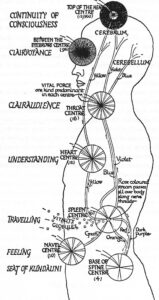
Leadbeater’s Chakra Functions (reprinted from A. E. Powell, The Etheric Double, 1925)
Any chakra system that mentions the spleen or the splenic chakra bears his influence. The origin of Leadbeater’s concept of the spleen chakra can be traced to Blavatsky’s implication of the location of the “spleen and liver” chakra in the master table of correspondences she created for her Inner Group Teachings (Esoteric Instruction No. 4).
Leadbeater’s identification of the spleen as the source of the vitality of the physical body may also be traced back to Blavatsky’s Esoteric Instructions, where she says “the spleen acts as the center of prana in the body, from which the life is pumped out and circulated.”
It may be that Leadbeater also followed up on Rudolph Steiner’s hints about the workings of this “wonderful organ” and combined them with his own clairvoyant investigations to produce a detailed schema of how this organ supplies rays of different colors to the organs of the physical body and the main chakras of the etheric body.
Leadbeater’s visions of the chakras as colorful, whirling wheels reigned supreme in much of the Western world for more than half a century. His multi-colored illustrations of the chakras reflect what he “saw” on the basis of his research into the ways in which vital energy circulates among the chakras of the etheric body. But perhaps the most notable contributions of his book to the Western chakra system are the names by which the major chakras are known today: root chakra, navel chakra, heart chakra, throat chakra, brow chakra, and crown chakra. A subtler contribution to the evolution of the Western chakra system is Leadbeater’s novel resolution of the question of the number of chakras, their locations, and their activities.
Controversy
Shortly after the publication of The Chakras in 1927, a Hindu spiritual teacher active in California, Rishi Singh Gherwal, published a passionate complaint against Leadbeater’s work, calling him “the greatest enemy of yoga philosophy.”
Going Further
The force fields of a higher body, also referred to as color bodies, appear to dictate to large degree the life and development of the physical organism. Each force center correlates to nerve plexuses in each one of those force centers. And there is always a colony of glands and organs around each one of these force centers related to them. Each is like a universe – its own little world.