
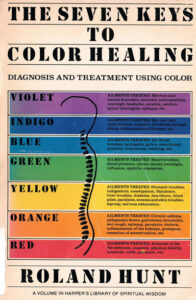
A TOUCHSTONE REVIEW:
The Seven Keys to Color Healing: A Complete Outline of the Practice *
by Roland Hunt
HarperCollins (1940, 1971)
* For this review, I have mined information on the history and influence of this book from Kurt Leland’s Rainbow Body: A History of the Western Chakra System from Blavatsky to Brennan (2016).
The Author: Roland Thomas Hunt (1900-1973)
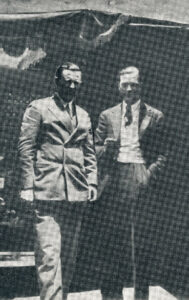
Roland T. Hunt (right) and the perfumer Prince Georges V. Matchabeli, with whom Hunt carried out experiments to show vibratory correspondences between color, sound, and smell. (Photo excerpt reprinted from Hunt’s book Lighting-Therapy and Colour Healing courtesy of Kurt Leland.)
Kurt Leland in his book Rainbow Body (p. 278) provides a brief but compelling character description of Hunt:
He fostered an image as a multitalented Renaissance man – anatomist, architect, artist, businessman in advertising and publicity, musician, physiologist, poet, psychologist, and spiritual healer/teacher. In his writings, he comes across as an ambitious, enthusiastic, humanitarian, idealistic, romantic visionary – and tireless self-promoter, in particular of his line of art-deco-style color healing (Spectrone) lamps. Based on the only photograph I have been able to examine and hints in his writings, Hunt seems to have been a charming, handsome, clothes-horse of a celebrity hound.
Hunt, a native of England, first visited the United States in 1923. By 1930, he had met Ivah Bergh Whitten and became her chief student. Hunt appears to have been the primary agent of transmission to the wider public of Whitten’s teachings, including her linkage of the spectral colors to the chakras. He actively promoted Whitten’s ideas in several books brought out by a commercial publisher in London. Seven Keys is one of them.
The Book
The subtitle of Roland Hunt’s book is “Diagnosis and Treatment Using Color.” And that is what the book offers from the outset. Hunt describes his book as a “practical text-book dealing exclusively with the application of Colour.”
He refers to color healing as a “Divine Science” and to cosmic color as a “Divine Force” that “travels in the fourth dimension.” Color, he says, “works on every plane…. Yet its greatest effectiveness is upon the spirit of man, in its influence on the consciousness.”
The author’s friend and teacher, Ivah Bergh Whitten, who wrote the foreword, explains that the purpose of the method of energy healing called “Colour Healing” is to reestablish color balance and cure one’s distress or disease. She also states that Hunt’s book mentions “colour-breathing” for the first time in print, a therapy which she developed, and says that the book holds the key to its practice.
Hunt humbly states in his preface that Seven Keys is an interim work intended to bridge the need for instruction in color healing while his teacher Whitten produces the master work on the subject, a book which she intended to title Using Colour. However, that promised work never came to fruition. Whitten passed away a few years later. Only Whitten’s correspondence course on color awareness was ever made public. Seven Keys presents the portions of Whitten’s course that connect the chakras and cosmic rays.
The correlations between the frequencies of color and vibration were a hot topic in the mid-twentieth century. And so it is intriguing that the book proposes, for the first time in the West, an eight chakra system – an octave of frequencies – and the concept of multiple color bodies.
Unlike contemporary books on chakra therapy, Hunt makes his case entirely without reference to Hindu, Tantric, Vedic, or Buddhist teachings (which he clumps together as “Indian philosophy”) and without using the terms subtle energy, kundalini energy, mantra (which he replaces with “affirmation”) or prana (which he refers to as “cosmic energy”).
The first four chapters of the book provide methods of physical, psychic, and spiritual diagnosis and treatments using color. Whitten promoted the practices of analysis and consultation to determine which color would most benefit an individual, practices which Hunt continues. The instructions in his book involve the construction of a properly lit environment for diagnosis as well as the use of colored solar energy and color therapy lamps for specific color treatments on particular parts of the human body.
Hunt’s fourth chapter, “Treating Consciousness,” explains the basic principles of color breathing for the enhancement or restoration of physical, mental, and spiritual well-being. This chapter also presents the concept that “disease in man, and the world, for the most part originates in consciousness and only later manifests in physical form…. Thus, in the spiritual use of Colour lies the greatest virtue.” It is a concept that is restated again and again in New Age chakra healing practices.
The technique of color breathing was the basis for numerous rewrites of Hunt’s book in more usable formats over the next forty years. However, the spiritual aspects of his theory have been disregarded in New Age practice of color therapy and in the contemporary seven chakra system, perhaps because his proposed eighth chakra is associated with no location on the physical body.
The remaining eight chapters of the book are devoted to each of the eight energy centers from red at the base of the spine to white at the top of the head and their color bodies. In these chapters, Hunt expands Whitten’s color correspondences to include metals, chemicals, foods, and color irradiation of the body for the alleviation of various physical and psychological illnesses. Each chapter identifies the nutritive sources of color in foods and solarized liquids and provides a detailed analysis of the color ray – its characteristics, effects, and uses in correcting various disorders.
In these chapters, Hunt makes some notable comments on the colors, yellow, indigo, violet, and white. He recognized that the color Yellow “has an enriching effect upon the intellectual departments of the brain” and that it “stimulates the Third Chakra, or Solar Plexus, the great brain of the nervous system.” and unlike his predecessor Charles Leadbeater, Hunt relates the pineal gland to the color indigo and the Third Eye Chakra and the pituitary gland to the color violet and the Crown Chakra.
To the color white, Hunt assigns, in Theosophical terms, the causal body and the “Christ-Light”: “In Colour Healing the White sunlight is used, in all its spectrum of Colour wavelengths, to run the motor organs of the human machine efficiently; not alone to restore the physical body, but to tone and refreshen the Mind and nourish the Spirit.”
“The White Ray,” he says, “is a symposium of All Seven Rays…. Spiritually, The White Light is the Divine Radiance of The Father of the Cosmos – the Logos. It is the Light of Christ-Consciousness…. There is a radiant relationship between the Spiritual Sun of God (The Christ) and the so-called physical Sun of our zodiacal system…. the Sun is one of the dynamic focal centres of Divine Energy.”
For this reason, Hunt emphasizes the value of consuming fruits and vegetables as they carry “the maximum cosmic and solar energy” and points to the example of certain yogis who draw in “all their needs direct from the Divine Cosmic Solar-Energy.”
All Hunt’s therapies are based on the primary necessity of unblocking self-made energy blockages that interfere with the process of “the White Light (Christ-light) drawn into the consciousness of the soul” being “diffused into its seven component colours, each one being sent to sustain the centre to which it has an affinity.” (A principle that harkens back directly to the process Leadbeater describes in The Chakras and which Leadbeater attributes to the work of the splenic center.)
The entire book is written in an innocent, entrepreneurial style. Innocent because the author displays no doubts, no questions, but rather a perfect trust in his teacher and her teachings. Entrepreneurial because he presents practical constructions and implements necessary for color treatments and diagnostics, including his own products. Hunt makes us feel that we, as interested readers, need only follow the instructions given in the book and find a clairvoyant healer to provide us the treatments in order to discover a new world of energy and being.
Hunt’s footnotes refer to his own earlier books that contain more detailed explanations of his concepts. They also refer to other source texts that inspired his blissful arguments for the powers of light and the angels.
Some of these references are to doctors and naturopaths of his and earlier times, whose physiological theories today are considered quackery by the medical establishment but whose effective practical advice is today being resurrected and refined by a new generation of naturopaths and alternative healers. Other references are to supernatural philosophers whose writings are unfortunately no longer available to the public except in overpriced used copies but whose eternal themes are clear from their titles.
Hunt drops the names of these individuals, sometimes quite casually as if the reader would recognize them immediately. Here is a list of them in order of their appearance:
- Dr. Edwin Babbitt – author of the monumental work The principles of Light and Colour (1878) and early practitioner of chromotherapy and hydrochromatic treatment
- Dr. C. E. Iredell – author of Colour and Cancer and cancer specialist at Guy’s Hospital in London during the 1920s who developed a treatment using a pulsing radionics instrument and who researched body vibrations
- Ivah Bergh Whitten – author of What Color Means to You, Colour Breathing
- Roland Hunt – author of Fragrant and Radiant Healing Symphony, Lighting Therapy and Colour Harmony, Colour and Diet
- Professor Arnold Ehret – German naturopath and alternative health educator
- Geoffrey Hodson, F.T.S – author of The Coming of Angels (1935)
- Dr. Ruth Drown – practitioner of alternative medicine, chiropractic, radionics, and blood sampling and inventor of the Drown Diagnostic and Treatment instrument, which is supposed to work fourth-dimensionally by color irradiation
- Vera Stanley Alder – author of The Fifth Dimension (1940) and Roland Hunt’s spouse from 1943-1956
- Paramhansa Yogananda – author of Scientific Healing Affirmations and Autobiography of a Yogi, and founder of the Self-Realization Fellowship
- Dr. Donald Laird – professor of psychology at Colgate University famous for his research into color and environment
- Dr. Alexis Carrel – French author of the best seller Man and the Unknown (1935), Nobel Prize winner, and believer in spiritual cures whose collaboration with the Nazis during the occupation of France in WWII stained his reputation
- Alexander Horne – author of Theosophy and the Fourth Dimension (1938) and promoter of the concept that color travels in the fourth dimension
- Dr. Seth Pancoast – author of Blue and Red Light; or, Light and Its Rays as Medicine (1877) and founding member of the Theosophical Society
- Jwala Prasad Jha – Indian color healer and author of Chromopathy, or, the science of healing diseases by colour (1912, 2021)
- Leonardo da Vinci – who attested to increased powers of meditation under rays of violet light
- Comte de St. Germain – who used purifying violet rays to heal the sick
- Adolphe von Gerhardt – famous German homeopath who charged ingested materials with colored light and authored Handbuch der Homopathie (1876)
- Baron Dr. Carl Ludwig von Reichenbach (1788-1869) – who researched the energy field or life force around living things, which he called “odic force”
- Alessandro Cagliostro – alias of a glamorous 18th-century Italian occultist, healer, magician, and forger who helped to diffuse Freemasonry and used his finagled wealth to found orphanages and maternity hospitals throughout Europe
- Louis Pasteur – who pointed out the healthful effects of sunlight
- Dr. Forbes Winslow – author of Light, and its influence on Life and Health (1868)
- Paul Brunton – author of A Search in Secret India (1934)
The book’s index provides a quick and easy reference list of physical and mental health conditions and diseases for which Hunt provides color therapy treatments. The bibliography provides a list of the English language texts of his time on color therapy.
The one notable exception in the bibliography is Charles Leadbeater’s The Chakras. This is significant because Hunt, like Leadbeater and unlike nearly everyone else, identifies a spleen chakra and because the first chapter of Seven Keys contains a diagram that is derived from Leadbeater’s book but is not acknowledged as such.
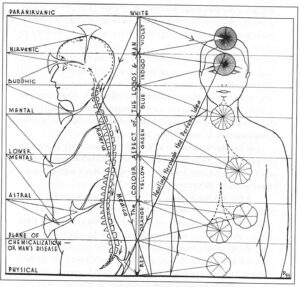
Chakras and Planes (Reprinted from Roland T. Hunt, The Seven Keys to Color Healing, 1940, 1971)
The diagram shows side and front views of a human torso with the locations of the chakras marked in each. The front view is acknowledged to be a reprint from Whitten’s book What Colour Means to You. Both illustrations are black-and-white outlines of color plates in Charles Leadbeater’s The Chakras (plate 8 and figure 2.5 in the 2013 edition).
The diagram cleverly superimposes the two illustrations in black-and-white outlines, linking each chakra to “the color aspect of the Logos and man” and to one of the psycho-spiritual planes of existence described by Leadbeater in his earlier books. Hunt borrowed Leadbeater’s diagrams and terminology without acknowledging this in his bibliography. But Hunt’s tabulation carried forward into the future Leadbeater’s notion of a spleen chakra and the names and locations of the chakras in Leadbeater’s chakra system. At the same time, Hunt followed Whitten’s lead by associating, for the first time in print, the chakras with colors in the order of the rainbow.
This diagram is perhaps the first graphic depiction of a connection between the concept of chakras and planes. The lines in the diagram link each of the seven chakras with the seven colors of the rainbow spectrum and their corresponding etheric/psychic planes, as well as an eighth plane linked to the color white:
LEADBEATER’S ENGLISH NAME | SANSKRIT NAME | COLOR | PSYCHIC PLANE |
Root Chakra (Sacral Chakra) | (Muladhara) | Red | Physical |
Splenic Chakra | (Svadhisthana) | Orange | Etheric |
Navel Chakra (Solar Plexus Chakra) | (Manipura) | Yellow | Astral |
Heart Chakra | (Anahata) | Green | Lower Mental |
Throat Chakra | (Vishuddha) | Blue | Upper Mental |
Brow Chakra (Third Eye Chakra) | (Ajna) | Indigo | Buddhic |
Crown Chakra | (Sahasrara) | Violet | Nirvanic |
--- | --- | White (called “Christ- Light” by Hunt) | Paranirvanic (meaning “beyond Nirvana”; also called the monadic plane by Charles Leadbeater) |
After Whitten and Hunt, the colors assigned to the chakras in the Western seven chakra system remain relatively stable. Because Hunt’s book remained in print for forty years, it kept Whitten’s association of colors and chakras current until they were combined with the chakra qualities that became ubiquitous in the 1970s.
Following Hunt, in the 1960s and later, other authors lifted significant chunks of material from Hunt’s Seven Keys and republished them without attribution. In this way, the association of chakras and rainbow colors was transmitted to spiritual seekers of the 1960s and 1970s. And so, the way was prepared for the assimilation of the rainbow colors into the chakra qualities developed within the human potential movement at the Esalen Institute at Big Sur, the birthplace of the New Age Western chakra system as we now know it.
The Author’s Mentor: Ivah Bergh Whitten (1873-1947)
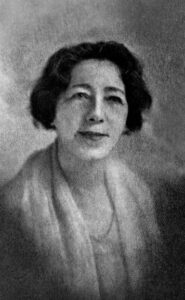
Ivah Bergh Whitten. (Reprinted from her book What Color Means to You (1932) courtesy of Kurt Leland.)
Neither Madame Blavatsky nor Charles Leadbeater nor Alice Bailey generated a list of color associations with the chakras in the order of the rainbow. This task fell to Ivah Bergh Whitten.
Going Further
The fact that Seven Keys identifies the number of chakras to be eight and associates the natural spectrum of colors to the chakras suggests that Whitten received some of her information from a solar adept. (Who this adept was will no doubt remain a mystery. It was customary a century ago, and earlier, to keep solar teachings secret.) Other clues in Hunt’s text suggest that both she and Hunt were familiar with the practice of absorbing solar energy through the eyes and force fields. However, their knowledge of solar practices, and the ultimate goal of such practices, appears to be incomplete.
Some observations from the perspective of the System of Cosolargy may be useful at this point.
As Hunt and Whitten knew, light and color can modify the psycho-physical color bodies and their related force centers. The methods Hunt describes to strengthen the force centers are similar to those used in Cosolargy, but the methods of color irradiation and heliotherapy available at present are more refined and varied than those available in the 1940s.
Cosolargy also uses a different method of diagnosis, and for a different purpose. Healing of the physical mind and body and the psyche are considered secondary benefits. The ultimate goal is to go beyond the duality of the physical and psychic bodies to regenerate the immortal Light body and a state of true spiritual Consciousness. Thus the System of Cosolargy offers a new perspective on the eight chakras or force centers.
As may be seen from the diagram below, the System of Cosolargy works with eight energy centers – the seven prismatic colors plus white – as does the color theory and therapy of Whitten and Hunt. But the plexuses specified and the colors associated to them differ from those in Seven Keys.
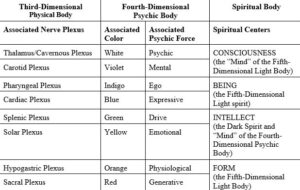
As the diagram indicates, the eight minor force centers of the psychic body (the chakras) issue in pairs out of the four major force centers of the spiritual body. Once you undertake the process of spiritual regeneration, in addition to the eight force centers which Cosolargy refers to as minor, you activate the four major force centers of your spiritual body, the body composed of your spiritual Consciousness, Being, Intellect and Form.
The Center of Form is your Light Body. Intellect is one of your spirits – the Dark spirit. Your Being is your Light spirit. And your Consciousness is the Intelligence – the mind, as it were – of your Light Body. It is through these four force centers that higher energy frequencies flow.
Activation of the force centers of the Light body brings the individual experience of a new intelligence that draws on the vast knowledge stored in the psyche. An entirely new beingness unfolds, and a supraconsciousness emerges, bringing with it tremendous creativity and awareness of nonphysical knowledge. This is what Cosolargy can teach you to do.