
A TOUCHSTONE REVIEW:
Wheels of Life: A User’s Guide to the Chakra System *
Llewellyn Publications (1987, revised 1999)
The Sevenfold Journey: Reclaiming Mind, Body and Spirit Through the Chakras
Crossing Press, 1993
Eastern Body, Western Mind: Psychology and the Chakra System As a Path to the Self
Clarkson Potter/Ten Speed (1996, 2004)
by Anodea Judith
* For this review, I have mined information on the history and influence of this book from Kurt Leland’s Rainbow Body: A History of the Western Chakra System from Blavatsky to Brennan (2016).
The Author: Anodea Judith (1952- )

Anodea Judith’s stepfather was a devout Christian Scientist. He kindled her interests in healing, and helped her discover the beneficial results of positive thinking and mind over matter. Christian Science as a religion, however, had no appeal for her. And so when she entered Clark University, it was with the idea of becoming a therapist.
Because she did not like the concentration on academic psychology rather than training in counseling, in 1973 she dropped out, became an artist, and moved to California.
In 1975 she realized that well-being and consciousness were essential components to the quality of her artistic expression and determined to transform her higher self. As part of her studies, Judith spent two months living alone in a tent on top of a California mountain.
As a teenager, Anodea Judith (born Judith Ann Mull) had already begun to identify with various aspects of the Greek goddesses while she studied mythology and practiced healing. There on the mountaintop, she spent her time becoming one with the elements and felt she received direct teaching from the goddess. The experience moved her to change her name to Anodea Judith (Anodea meaning “one who serves the goddess”).
She first encountered the concept of chakras in the book The Only Dance There Is by Ram Dass, the popular New Age guide to spirituality. She later had a vivid out-of-body experience in which she saw a book on the chakras written by herself.
This experience initiated a decade-long study of chakras, the meridian system of Chinese acupuncture, bioenergetics, meditation, yoga, gestalt therapy, radical psychiatry, ritual magic, shamanism, psychic readings, and New Age energy healing. The result was the writing and publication of Wheels of Life.
The success of this book established Judith as a leading teacher on chakras and healing, and she began extensive traveling to present workshops and lectures.
In 1989 Judith received a Master’s degree in clinical psychology from Rosebridge Graduate School of Integrative Therapy; and in 1999, after ten years of therapeutic practice, she received a Ph.D. in health and human services, with a concentration in mind and body health, from Columbia Pacific University.
Since then Judith has worked as a somatic psychotherapist, traveling the world to train other teachers and therapists in her work through her own organization, “Sacred Centers.”
The Books
Wheels of Life: A User’s Guide to the Chakra System
The 1980s were a period of consolidation of teachings on the chakras in both the East and West. During this time, Judith began combining information from various systems into a coherent whole in the attempt to resolve the great chakra controversy concerning the number of chakras, their names, their locations, their corresponding colors, and their functions.
When Judith published Wheels of Life, it became the first formal codification of the now ubiquitous Western chakra system. It is considered by some to describe the standard model.
The book represents a comprehensive synthesis of then-current teachings in America, with emphasis on clearing the major chakras to prepare the way for kundalini awakenings that are less tumultuous than they would be otherwise
In this book, Judith includes some correspondences to chakras about which there is less agreement in the writings of subsequent authors, such as foods, gemstones, incense, metals, planets, yoga paths, and the sephiroth of the Jewish Kabbalah. She also makes the controversial identification of the pineal gland with the sixth chakra and the pituitary with the seventh.
The focus of Wheels of Life is an in-depth examination of what each chakra does and how to unblock, balance, and strengthen the main chakras to achieve mental health and vital energy. The revised edition includes chapters on relationships, evolution, and healing, as well as a section on raising children with healthy chakras. Tables assign to each chakra region of the human energy body their corresponding color, qualities, minerals, energy states, psychological functions, identity, counterforce, developmental stage, and malfunctions.
Her descriptions and commentaries use powerful images and philosophical and psychological language that is well suited to the general public and make difficult concepts generally accessible. Her explanations of complex primary principles make clear what explanations in other books make complicated.
Quotes from the Sanskrit texts of Hinduism and famous authors appear as epigraphs to chapter sections throughout the book. These quotes present the ideas of many of the popular alternative healers and thinkers of the time, primarily from the 1970s and1980s, as well as Hindu teachers and Indian yogis. These ideas and concepts – new at the time – are explained with down-to-earth examples, making them, too, easily accessible.
As a manual of self-development and spiritual awakening, Wheels of Life also involves experiential components. The book associates specific yoga postures and other physical exercises as therapies for each chakra region of the human body.
In the introduction, Judith provides the reader with a list of “introductory conclusions.” These are statements of the basic theories and biases which the book presents and which she accepts without question. This list is most helpful because her statements lay out the author’s starting points – the concepts and assumptions which she inherited or adopted, primarily from the Western seven chakra system that originated at Esalen Institute in the 1970s.
The book, and her discussion, is organized in three parts. Part 1: “Exploring the System” is an introductory chapter that acts as a kind of springboard for the reader to begin their experience. Part 2: “Journey Through the Chakras” consists of seven chapters, each one describing the energies of one of the chakras in the Western chakra system. Part 3: “Putting It All Together” comprises five chapters that apply an understanding of the chakras to the world around us.
Among these five final chapters, three stand out. One provides a means to analyze the relative strength and weakness of individual chakras through self-testing. Another lays out an interpretation of the evolutionary history of modern man over the past 30,000 years using the movement rising through the chakras as a map for the “collective journey.” A third lays out how the chakras develop sequentially from the base of the spine to the top of the head as an individual matures from birth to adulthood and gives simple advice for parents on how to support the unfolding of the chakras in a child’s life. (The discussion of individual childhood development is expanded upon further, chakra by chakra, in her later book Eastern Body, Western Mind.)
At the end of Wheels of Life are an accessible glossary of Sanskrit terms, a recommended reading list for each chakra, a well-rounded annotated bibliography of alternative-view books from the 1960s-1990s, and a meticulously detailed topical index.
The Sevenfold Journey: Reclaiming Mind, Body and Spirit Through the Chakras
The Sevenfold Journey is the workbook to Wheels of Life. It presents a thoroughly experiential approach based on Judith’s tables of correspondences and the information in Wheels of Life by providing extended practice in yoga, psychotherapy, movement, and ritual that corresponds to the underlying metaphysical theory in Wheels of Life.
The Sevenfold Journey is co-authored with Judith’s teaching partner Selene Vega. With her, for the six years following the publication of Wheels of Life, she led groups in their popular training program Nine Month Chakra Intensive and created teaching materials from their experience along the way. This workbook is a compilation of those materials.
Based on these workshops, The Sevenfold Journey intends to provide a step-by-step approach to healing and balancing one’s life for individual, self-paced practice. The book includes discography, photographs of the exercises, vocalization exercises (mantras), and instructions for setting up accompanying rituals.
Techniques range from meditations and journal exercises to rituals and political activism. Included are contemporary psychotherapeutic approaches, yoga, bioenergetics, interactive exercises, and mundane assignments as well as art, music, and dance projects. The physical exercises and yoga postures reproduce those presented in Wheels of Life, expanding upon them and adding to them.
This workbook also provides suggestions for setting up altars for each of the chakras to help the practitioner change focus as they enter the “sacred space” of a specific chakra in the exercises, in case it “may be important for an individual to focus on a particular chakra if that chakra has been underdeveloped in their life.”
Eastern Body, Western Mind: Psychology and the Chakra System As a Path to the Self
In Eastern Body, Western Mind, Judith shows the reader how to use the standard Western seven-chakra system as a tool for diagnosis and healing.
She brings a fresh approach to the Western seven-chakra system by adapting it to Jungian psychology, somatic therapy, childhood developmental theory, and metaphysics and by applying the system to modern social realities and issues such as addiction, codependence, family dynamics, sexuality, and personal empowerment. Judith does not repeat herself in this book, except to refine and expand upon what she has said in earlier publications.
Also provided are a look at the traumas and abuses that happen on the level of each chakra and suggestions for healing therapies to address these problems. In this regard, Judith often refers to the grounding exercises and the body work in her earlier workbook, The Sevenfold Journey.
Eastern Body, Western Mind is arranged schematically and uses the structure of the chakra system as a map to chart individual development through the journey of individuation and awakening. Each chapter in the main body of the book focuses on a single chakra, starting with a description of its characteristics and then exploring its particular childhood developmental patterns, traumas and abuses, and methods of healing. Importantly, Judith delves into the psychology of the chakras following the same pattern of psychological topics for each chakra: balance, deficient and excess energy, character structure, developmental stage, issues, and traumas and abuses.
The book intends to teach an elegant system for understanding health and imbalances and effectively applying universal principles. The book also presents in greater detail Judith’s theory that the chakras develop sequentially during crucial stages of childhood. In this way, Eastern Body, Western Mind makes the standard Western chakra system relevant to daily life. Judith writes with the clear understanding that yoga, while able to connect mind and body, fails to heal the wounds of the psyche.
Eastern Body, Western Mind is purely psychological, a melding of the Western seven-chakra system and Jungian psychology. There are no recommendations of physical exercises or references to physical organs in this book. These appear in Wheels of Life.
The exercises too are psychological and aimed at the individual reader who desires healing. They integrate bioenergetics, visualization, and Carl Jung’s depth psychology. In this way, the book provides a systematic means of tying together the world of inner transformation with an understanding of the outer forces that had shaped that inner world in the first place.
Eastern Body, Western Mind demonstrates the basic psychological constructs that Judith uses in her therapeutic practice: the seven basic chakra identities assigned by New Age theory (with her own slight modifications), the five basic character structures identified by Wilhelm Reich, and the four basic patterns she recognizes in the movement of unbalanced energy.
Throughout the book, Judith uses these constructs to place modern psychological issues within a spiritual context. Her style of therapy abounds with the psychoanalytical concepts of Carl Jung and Erik Erikson.
The book closes with this conceptual image:
Each chakra represents an essential chamber in the temple of the Self. Each one houses an aspect of the sacred and is necessary for wholeness. The more we clean and properly decorate the temple, the more we court the presence of the divine. We build a temple to the gods by creating, clearing, and restoring each of the chambers of the chakras.
Basic Principles of Judith’s Chakra Theory
-
The Chakra System
Judith defines chakras as centers of organization that receive, assimilate, and express life force energy – spinning spheres of “bioenergetic activity emanating from the major nerve ganglia branching forward from the spinal column” – connected by a nonphysical channel running straight up the center of the body called the sushumma. Two alternate channels or nadis are subtle energy conduits that travel beside, around, and through the sushumma. These “control the yin and yang energies … twisting in figure-eight patterns around each chakra and running alongside the sushumma.”
Judith calls the chakra system a “philosophical model of the universe.” Her work is therapy, not scientific study. And so her books provide nothing like scientific evidence for the existence of chakras. She doesn’t ask, Are chakras real? Rather, her books are treatises on the ways energy works within our “inner psychology.”
Her books examine the correlation of the chakras with the basic states of consciousness. She sees them as patterns of consciousness in the mind, programs that run our lives:
We all function by sets of programs, which may or may not be conscious…. In this analogy the body is the hardware, our programming is the software, and the Self is the user…. To identify our programs and rewrite them, all while continuing our lives, … is the task of healing…. In order to run any of our programs, we have to activate our energy currents.
-
Energy Flow
“Our understanding of the chakras,” she says, “comes from a pattern analysis of energy flowing through a person’s body, behavior, and environment.”
The chakras are “sacred chambers in the temple of the body, where the vital force of consciousness can pool together on different levels.” In these chambers, the upward-flowing liberating current mixes with the downward-flowing manifesting current:
Energy flows in two ways in the chakra system – vertically, as it passes up and down connecting all the chakras, and horizontally, as it passes into and out from each chakra, interfacing with the world outside. The vertical channel can be thought of as the basic source, while the horizontal flow is the expression of that source…. Pure consciousness, which enters the individual from the vast field of the supramental plane as purusha, condenses through the chakras as it falls downward to the plane of manifestation….
In the journey upward, we use the chakras as stepping stones to our liberation…. In the downward current, the chakras become ‘condensers’ of the force of consciousness…. Where there is a cavity, water collects in pools and can be used. Like pools, the chakras are chambers in the subtle body that allow the divine consciousness to collect.
Judith calls the downward flow of energy the current of manifestation and the upward flow the current of liberation. The two horizontal currents flowing into and out of each chakra she calls the current of reception and the current of expression.
-
Energy Blockages
An energy blockage can be due to a chakra being “closed.” That is, a chakra may be “unable or afraid to handle energy at that particular level; or it can be due to one that is too open, meaning that all attention and activity is consistently drawn to that level, at the expense of other levels.”
If a chakra is blocked in a closed state, then it is unable to generate or receive energy on that particular plane; if a chakra is blocked in an open state, all energies tend to channel through that particular plane:
When a chakra is blocked, reception and expression become distorted…. Furthermore, any block in a specific chakra affects the flow of the four basic currents…. For this reason, it is important to recognize the blocks we carry, find ways to understand their source and meaning, and develop tools to heal them.
-
Chakra Identities
“Each of the chakras is associated with a particular identity that emerges developmentally as we mature through life…. The identities can be seen as metaphoric layers of clothing, as ways to cover the essential soul underneath…. When we are so immersed in these identities that we confuse them with the underlying Self, then we have gotten stuck at a particular level…. The chakra identities … are simultaneously real and false. They are real in that they are real parts, yet they are false because they are not the whole.”
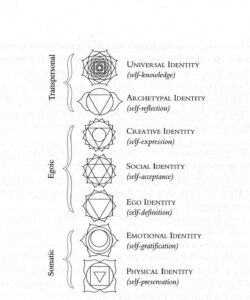
Figure 0.8 IDENTITIES from Eastern Body, Western Mind, p. 29
The two upper chakras “correspond to the areas Jung called the supra conscious, or that others have called transcendent, transpersonal or cosmic consciousness.” The two lower chakras are “the realm of instincts and the unconscious mind.” The three middle chakras “are largely run by [the] egoic consciousness as it interacts with the outer world and integrates experience on the inner planes.”
-
Chakra Development
“Typically, the chakras evolve sequentially, from bottom to top, along with our chronological age.”
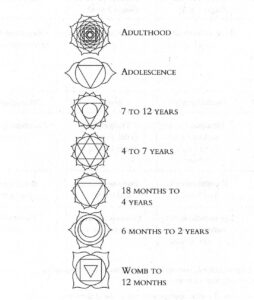
Figure 0.10 DEVELOPMENTAL STAGES from Eastern Body, Western Mind, p. 3
“Difficulties occurring during any of these crucial stages can affect the chakra that is developing at that time, as well as the chakras that follow.”
-
The Process of Individuation
According to Judith, the chakra system is an archetypal pattern similar to Jung’s archetype of wholeness, the Self:
Jung saw the totality of the Self as the central archetype of order in the psyche, the formative principle of individuation…. [The] archetype of the Self contains the program to become whole, much like a seed contains the program to become a flower.
What Jung called individuation is itself an archetypal process that “mirrors” the unfolding of the chakras:
Chakra development during childhood is relatively unconscious. Adult development, by contrast, is largely conscious – we have to want to develop, or it may not happen at all…. Adult development is often arrested by childhood conflicts.
Judith recommends her books to aid in this process:
If you find that you have not gotten very far on some of these levels, then this book is for you. It will help you find where you might have gotten stuck and explain how to proceed on the path of liberation.
How to Use These Books
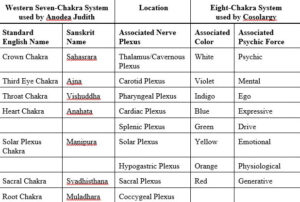
The System of Cosolargy works with eight energy centers, and the plexuses and the colors associated with them differ from those in the standard Western seven-chakra system.
Although Judith has adopted the color assignments of the standard Western seven-chakra system, she does not use or even mention color in any of her therapies. However, Judith does associate the therapies she employs with regions of the physical body that correspond to specific nerve ganglia or glands. And so, in order to make correspondences between Judith’s suggested therapies and the eight-chakra system used in Cosolargy, the diagram below associates her therapies with nerve ganglia or glands rather than colors or numbers.
Establishing these correspondences between the two different chakra systems makes it is possible for users of the eight-chakra system to practice the healing techniques Judith presents in her books while practicing the color therapy and heliogenics techniques recommended in The System of Cosolargy.
Going Further
-
The Psychic Body
Judith tells us how to heal the regions of the physical body associated with each of the chakras through knowledge of the psychic traumas that affect those regions. And she uses the standard Western seven-chakra system as a scaffold structure to organize and build her own therapeutic analysis and discussion of health of mind and body. She even goes a bit further, stating that development of the chakras can form a psychic body.
According to her, the yogic goal of yoking the individual with the divine is achieved by passing through steps of ever-expanding states of consciousness. The chakras represent these steps. And correct practice of tantra can lead to the creation of the “mystic child,” a “psychic ‘aura body,’ experienced as an added energy source of a higher dimension.”
However, she does not promote the use of energy from an outside source, such as light or color in her books, but only therapies of self-analysis and physical exercises. And what entails the “correct practice of the tantric arts” she does not say.
-
Balancing the Chakras
Judith talks about balancing the chakras and strong or weak chakras, and she talks about using strong chakras to strengthen weak ones, but she does not talk about how to empower all the chakras to reach their optimal strength. For Judith, healing is the restoration of balance. The therapies she promotes in her books are designed to clear or clean chakras, not to build them up or energize them. She does not consider that nourishment from an outside source is required to activate the chakras. Neither does she exhibit an awareness that ultimate balance comes from nourishing each chakra through the energy of an outside spiritual force until they all operate at optimal strength.
-
The Concept of Consciousness
Judith recognizes two types of consciousness: Cognitive Consciousness which “actively thinks, reasons, learns, and stores information” and Transcendent Consciousness which “interfaces to a realm beyond the world of things and relationships.” She states that her concept of transcendence is “the awareness of the divine without.” Yet develops the concept no further and tells only how to approach it, not attain it.
-
The Spiritual Body
When Judith considers the mystical question “What was the face you wore before you were born?” it is for her simply a paradox, another Zen koan. “The idea,” she says, “is not to find an answer but to allow the question to knock down the barriers of your normal logical mode of thinking, and allow perception of something greater.” Her comment displays the popular Western understanding. But there is more to such questions in practice.
The famous Zen Buddhist question which she quotes is in line with other statements in spiritual literature like “glorify me with your own self with the glory which I had with you before the world was” (Gospel of John 17:6) and “when you fashion eyes in the place of an eye, and a hand in place of a hand, and a foot in place of a foot, and a likeness in place of a likeness; then will you enter the kingdom” (Gospel of Thomas, logion 22). These statements are not meant to be mere consciousness-raising mental exercises. They are references to a real body – the Spiritual Body of Light.
-
Religion
Judith talks about the concept of the term religio (the Latin root of the word religion) as a re-linking that “brings us back to core principles.” In her case, this is a re-linking with Earth as a spiritual center that leads to an Earth-centered spirituality and mythology.
The concept of re-linking to or the restoration of an immortal soul seems foreign to her thinking. The “return home” for her brings one only to “the realm of reflexive consciousness, becoming aware of ourselves and our process.”
-
Spirit and Soul
Judith sees the physical body as the “container of the soul” and soul as “an immanence within the individual.” And “immanence,” she says “is the restoration of the sacred.” And so it seems that, in Judith’s theory, the divine manifests in the material world through the process of individual self-transcendence, the presence of greater awareness in the individual of the kind posited by some of the popular forms of Tantric Buddhism.
In Judith’s terms, the soul is something that “tends to coalesce toward body, leaning toward form, attachment, and feeling.” The soul is “like a gatherer of spirit, forming the abstract into a composite being…. enhanced by the presence of spirit, as if spirit is the essence from which it forms.” And spirit is something that “tends to move toward freedom and expanded consciousness.”
Out of these concepts she fashions an ultimate tautological definition of both: “Soul is the individual expression of spirit, and spirit is the universal expression of soul.”
Judith recognizes that as we collectively refine our inner being and raise our consciousness, we collectively refine the world and collectively rise to a higher state of being and consciousness in this world – something like Teilhard de Chardin’s noosphere, which she does make reference to.
Yet, from Judith’s perspective, the individual spiritual journey is all important: “And so we find that the end is the beginning. We are not traveling a linear path, but an interpenetrating one. There is no destination, only the journey.”
Her statement contains a veiled logic: If there is no destination, there can be no spiritual destiny; and so, no higher spiritual world. If there is no higher spiritual world, there can be no higher spiritual being. If there is no higher spiritual being, there can be no higher spiritual form – no higher spiritual body and no higher spiritual consciousness; and so, by default, no spiritual immortality.
The spiritual school of Cosolargy offers a new perspective on the fullness of spiritual being and a new direction in the quest for spiritual consciousness.