
INTRODUCTION
No scientific evidence supports the existence of the chakra system in the spiritual sense. No scientific evidence can. Centuries ago, Western science discarded all notions of a vital energy or force. (The Vedic science of Hinduism calls this life force prana, the Sanskrit word for “breath.”) However, modern science did retain concepts of invisible physical forces. Strict empiricists frequently object even to this.
The concept of “field” in physics refers to a nonphysical element that interacts with the object within it. Because a field is nonphysical, the instruments of science cannot detect it directly. Science can only investigate its actions and effects.
Science has created the term biofield to replace terms used by metaphysicians and spiritual practitioners like energy body, psychic body, subtle body, and etheric body. Science has also created the term biofield practitioner to replace terms like yogi, meditator, energy healer, and spiritual adept in case studies.
This biophysical paradigm embraces a “field” view of life that complements the dominant “particle” view. Within this paradigm, a body’s biofield is a field of energy that holds information central to its higher order of being. The biofield is proposed to have mind-like properties. It is considered to be the super-regulator of the biochemistry and physiology of the organism that coordinates all life functions, and it is key to understanding life’s integral wholeness.
Some scientists have argued that the human body involves an electromagnetic communication system. They say that the traditional locations of the main chakras align closely with the endocrine glands of the body and with major nerve plexuses of the central nervous system.
BACKGROUND
Anatomical and Physiological Evidence for Chakras
Scientific research into the subject of the chakra system has been meager and sporadic. Despite this fact, Dr. Margaret Moga, a professor at the Indiana University School of Medicine compiled a review of the research that exists. She searched out evidence of the chakras in clinical research from the 1970s-2020s (Moga, 2022).
The Body Electric
The energy body or etheric body is where the most powerful and profound interactions in our beings take place. Mystics and practitioners of energy healing have long known this body. Recently scientists too have verified its existence under the term biofield.
1930s-1970s
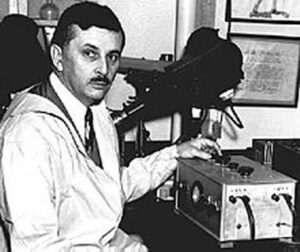
Harold Saxon burr IMAGE: Yale University Library
In the 1930s Harold Saxton Burr, Professor of Anatomy at Yale University School of Medicine and researcher into bio-electrics, made observations that led him to propose an electrodynamic theory of life. His main hypothesis was that bioelectric gradients serve as prepatterns. He proposed that these prepatterns guide the biological process that causes a cell, tissue, or organism to develop its shape. These patterns of forces in the electrodynamic field also influence growth and development. They determine the pattern of living things. Modern molecular physiology has now confirmed this fact. The same for Burr’s ideas about the place of the nervous system in biological organization (Levin, 2020).
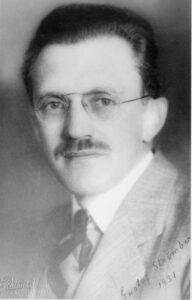
Gustaf Stromberg IMAGE: Ervin Willard Spurr, The Huntingdon Library
During the 1930s-1940s, the renowned astronomer Gustaf Stromberg further developed Burr’s concept of the life field theoretically. Alongside his work at Mount Wilson Observatory, he began to consider the nonphysical world. In 1940 he published his thoughts in the book The Soul of the Universe (1940, 1948). In this book, and in a number of articles published in various scientific journals, he called the life field an “autonomous field” or “organizing field.” He proposed that this field determines the location of particles and not vice versa.
2010s-2020s
Burr’s theory, his approach, and his work were largely forgotten by the scientific world until the 21st century.
The Human Body as Communications Network
The biophysical view is based on the existence of an organizing field within and around every living organism. This organizing field carries bioinformation central to regulating the organism’s life functions. In this view, living systems are constantly exchanging energy that carries information.
The endocrine system is a messenger system. It is comprised of feedback loops of hormones that internal glands release directly into the circulatory system. In this way, hormones target and regulate distant organs. The hypothalamus is the neural control center for the endocrine system. It is located in the brain adjacent to the pituitary gland. This is the location traditionally assigned to the “crown chakra” or “Sahasrara chakra” in Vedic science. One of the most important functions of the hypothalamus is to link the endocrine system to the nervous system via the pituitary gland.

The Hypothalamus-Pituitary Complex IMAGE: Wikimedia Commons
Each of the plexuses in the nervous system is like an electrical junction box in a house. In them, nerve fibers from different spinal nerves are sorted and recombined, so that all fibers going to specific body parts are put together in one nerve. And these nerves have both sensory and motor functions.
Both the nervous system and the endocrine system are involved in electrical communication.
Bioelectric phenomena occur throughout the physical body. Lipid membranes, flat sheets that act as insulators bathed in a conducting milieu, form a continuous barrier around all cells. All bilayer lipid membranes can support a membrane voltage and an electric field between membranes. The lipid bilayer allows selective passage of certain molecules and ions into and out of cells (McLaughlin, 2018). Membrane voltage modulates the energy available to all molecules that are associated with the membrane. This simple fact has wondrous and far-reaching implications (Cohen, 2014).
There is more to biocommunication than these two major communication systems and the lipid membranes. There is in the physical body a vast fluid superhighway that spans the entire body. This highway travels between organs, from one organ to the other. It connects everything to everything else throughout the body. It is called the “interstitium.” It is an important organ not discovered by Western science until 2018. But since ancient times, Indian Ayurvedic medicine has known it as the “nadis.” And ancient Chinese medicine has known it as the “meridians.” It is the network of acupuncture, the pathways through which the life energy known as “chi” flows (Brandel, Theise, 2023).
The structure of the interstitium is fractal. That is, it exhibits the same pattern at various scale. And it is unified. Scientists had seen glimpses of this mesh-like network before. But they had not realized that it connects the entire body — just underneath the skin, wrapping around organs, arteries, capillaries, veins, head to toes. It moves four times more fluid through the body than the vascular system does. And the fluid is a clear, “pre-lymphatic” substance that carries within it nutrients, information, and new kinds of cells.
The physical body is made up of cells. The interstitium is the something in between cells and around cells that keeps things together. Layers of collagen fibers in a thick, woven mat keep the organs together. And they give structure to every visceral organ throughout the body.
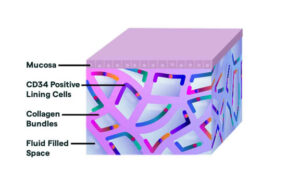
The interstitium IMAGE: Arthur Jones
The walls of living organs glow in a regular honeycomb sponge form that is full of holes, with translucent threads encasing the organs. Places throughout the body that researchers had always thought were solid structural stuff are not. They are actually shot through with little tubes and tunnels that flow from tissue to tissue, from organ to organ, reaching bigger streams that come together in big rivers. Twenty-five percent of the fluids going through our body is this stuff, four times the amount of blood. And in the interstitium are telocytes. They are a newly-discovered cell that appears to have a role in immune response regulation and cell-to-cell communication or signaling.
The Radiant Body
All living organisms emit ultraweak photons in ultraviolet frequencies and in the visible region, 400-700 nm (violet to red light). They are called “biophotons” (from the Greek meaning “life-light”).
THE PROBLEMS
As a whole, there currently seems to be no meaningful way to measure the chakra system scientifically. Scientists perceive only what their technologies permit, and their theories are constrained to what their technologies enable them to observe. And the current scientific paradigm continues to be materialistic and ignores consciousness.
THE SOLUTION
More research is needed to investigate the science behind chakras directly. We need a new scientific worldview that is more encompassing. And we need new scientific approaches in basic and clinical research.
CONCLUSION
As a whole, there currently seems to be no meaningful scientific way to measure the energy centers called “chakras.” No scientific evidence can support the existence of chakras in the spiritual sense. But there are scientists who argue that the primary chakras may correspond to endocrine glands and to different nerve plexuses of the central nervous system.
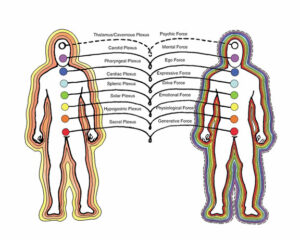
Science will require revision to embrace the full human potential of consciousness and the multidimensional nature of our existence. Life is inherently complex, and science should be mature enough to embrace its complexity. From a systems view, we can expect new biological principles at higher levels of organization. Science and spirituality may not currently be in synch, but fortunately there have been and are scientists who are also spiritual seekers.
ADDITIONAL RESOURCES
Jennifer Brandel. “Invisible Landscapes” OrionMagazine.org (2023)
Harold Saxton Burr. The nature of man and the meaning of existence. Charles C. Thomas (1962)
Rajesh Kumar Manik. “Neuro-anatomical and Physiological Study on Shadachakra” Research Gate (2023)
Sarah Murphy LPD. Transformative Therapy blog.
F.A. Popp and W. Nagl. “Concerning the question of coherence in biological systems” Cell Biophysical Journal 13: 218-220. (1988)
F.A. Popp, U. Warnke,, H.L. Konig, W. Peschka,(eds.). Electromagnetic Bio-information. Munich: Urban and Schwarzenberg. (1989)
Lacey Gibson Ramirez. “Yoga’s Energy Centers: What Science Says About the Chakras” (January 5, 2020)
Rupert Sheldrake. Morphic Resonance: The Nature of Formative Causation. Park Street Press (2009)
Gustaf Stromberg. Soul of the Universe. Philadelphia: David McKay Company (1948)
R.V. Wijk, E.P. Wijk. “An Introduction to Human Biophoton Emission” ( 2005)
Griff Williams. “Chakra Science: Bridging the Gap between Spirituality and Biology” Mind Easy (2023)