
A TOUCHSTONE REVIEW:
Wheels of Life: A User’s Guide to the Chakra System *
Llewellyn Publications (1987, revised 1999)
The Sevenfold Journey: Reclaiming Mind, Body and Spirit Through the Chakras
Crossing Press, 1993
Eastern Body, Western Mind: Psychology and the Chakra System As a Path to the Self
Clarkson Potter/Ten Speed (1996, 2004)
by Anodea Judith
* For this review, I have mined information on the history and influence of this book from Kurt Leland’s Rainbow Body: A History of the Western Chakra System from Blavatsky to Brennan (2016).
The Author: Anodea Judith (1952- )

Anodea Judith’s stepfather was a devout Christian Scientist. He kindled her interests in healing, and helped her discover the beneficial results of positive thinking and mind over matter. Christian Science as a religion, however, had no appeal for her. And so when she entered Clark University, it was with the idea of becoming a therapist.
Because she did not like the concentration on academic psychology rather than training in counseling, in 1973 she dropped out, became an artist, and moved to California.
The Books
Wheels of Life: A User’s Guide to the Chakra System
The 1980s were a period of consolidation of teachings on the chakras in both the East and West. During this time, Judith began combining information from various systems into a coherent whole in the attempt to resolve the great chakra controversy concerning the number of chakras, their names, their locations, their corresponding colors, and their functions.
When Judith published Wheels of Life, it became the first formal codification of the now ubiquitous Western chakra system. It is considered by some to describe the standard model.
The book represents a comprehensive synthesis of then-current teachings in America, with emphasis on clearing the major chakras to prepare the way for kundalini awakenings that are less tumultuous than they would be otherwise
The Sevenfold Journey: Reclaiming Mind, Body and Spirit Through the Chakras
The Sevenfold Journey is the workbook to Wheels of Life. It presents a thoroughly experiential approach based on Judith’s tables of correspondences and the information in Wheels of Life by providing extended practice in yoga, psychotherapy, movement, and ritual that corresponds to the underlying metaphysical theory in Wheels of Life.
Eastern Body, Western Mind: Psychology and the Chakra System As a Path to the Self
In Eastern Body, Western Mind, Judith shows the reader how to use the standard Western seven-chakra system as a tool for diagnosis and healing.
She brings a fresh approach to the Western seven-chakra system by adapting it to Jungian psychology, somatic therapy, childhood developmental theory, and metaphysics and by applying the system to modern social realities and issues such as addiction, codependence, family dynamics, sexuality, and personal empowerment. Judith does not repeat herself in this book, except to refine and expand upon what she has said in earlier publications.
Basic Principles of Judith’s Chakra Theory
-
The Chakra System
Judith defines chakras as centers of organization that receive, assimilate, and express life force energy – spinning spheres of “bioenergetic activity emanating from the major nerve ganglia branching forward from the spinal column” – connected by a nonphysical channel running straight up the center of the body called the sushumma. Two alternate channels or nadis are subtle energy conduits that travel beside, around, and through the sushumma. These “control the yin and yang energies … twisting in figure-eight patterns around each chakra and running alongside the sushumma.”
-
Energy Flow
“Our understanding of the chakras,” she says, “comes from a pattern analysis of energy flowing through a person’s body, behavior, and environment.”
-
Energy Blockages
An energy blockage can be due to a chakra being “closed.” That is, a chakra may be “unable or afraid to handle energy at that particular level; or it can be due to one that is too open, meaning that all attention and activity is consistently drawn to that level, at the expense of other levels.”
-
Chakra Identities
“Each of the chakras is associated with a particular identity that emerges developmentally as we mature through life…. The identities can be seen as metaphoric layers of clothing, as ways to cover the essential soul underneath…. When we are so immersed in these identities that we confuse them with the underlying Self, then we have gotten stuck at a particular level…. The chakra identities … are simultaneously real and false. They are real in that they are real parts, yet they are false because they are not the whole.”
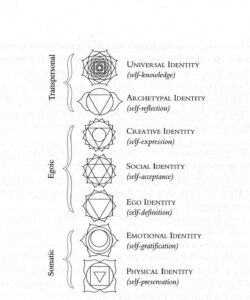
Figure 0.8 IDENTITIES from Eastern Body, Western Mind, p. 29
The two upper chakras “correspond to the areas Jung called the supra conscious, or that others have called transcendent, transpersonal or cosmic consciousness.” The two lower chakras are “the realm of instincts and the unconscious mind.” The three middle chakras “are largely run by [the] egoic consciousness as it interacts with the outer world and integrates experience on the inner planes.”
-
Chakra Development
“Typically, the chakras evolve sequentially, from bottom to top, along with our chronological age.”
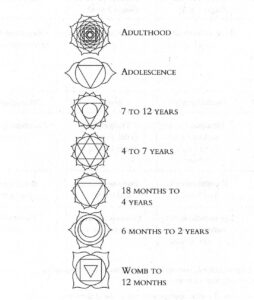
Figure 0.10 DEVELOPMENTAL STAGES from Eastern Body, Western Mind, p. 3
“Difficulties occurring during any of these crucial stages can affect the chakra that is developing at that time, as well as the chakras that follow.”
-
The Process of Individuation
According to Judith, the chakra system is an archetypal pattern similar to Jung’s archetype of wholeness, the Self:
How to Use These Books
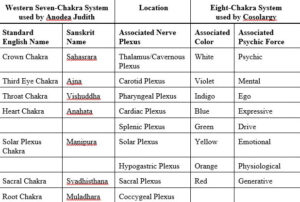
The System of Cosolargy works with eight energy centers, and the plexuses and the colors associated with them differ from those in the standard Western seven-chakra system.
Although Judith has adopted the color assignments of the standard Western seven-chakra system, she does not use or even mention color in any of her therapies. However, Judith does associate the therapies she employs with regions of the physical body that correspond to specific nerve ganglia or glands. And so, in order to make correspondences between Judith’s suggested therapies and the eight-chakra system used in Cosolargy, the diagram below associates her therapies with nerve ganglia or glands rather than colors or numbers.
Establishing these correspondences between the two different chakra systems makes it is possible for users of the eight-chakra system to practice the healing techniques Judith presents in her books while practicing the color therapy and heliogenics techniques recommended in The System of Cosolargy.
Going Further
-
The Psychic Body
Judith tells us how to heal the regions of the physical body associated with each of the chakras through knowledge of the psychic traumas that affect those regions. And she uses the standard Western seven-chakra system as a scaffold structure to organize and build her own therapeutic analysis and discussion of health of mind and body. She even goes a bit further, stating that development of the chakras can form a psychic body.
-
Balancing the Chakras
Judith talks about balancing the chakras and strong or weak chakras, and she talks about using strong chakras to strengthen weak ones, but she does not talk about how to empower all the chakras to reach their optimal strength. For Judith, healing is the restoration of balance. The therapies she promotes in her books are designed to clear or clean chakras, not to build them up or energize them. She does not consider that nourishment from an outside source is required to activate the chakras. Neither does she exhibit an awareness that ultimate balance comes from nourishing each chakra through the energy of an outside spiritual force until they all operate at optimal strength.
-
The Concept of Consciousness
Judith recognizes two types of consciousness: Cognitive Consciousness which “actively thinks, reasons, learns, and stores information” and Transcendent Consciousness which “interfaces to a realm beyond the world of things and relationships.” She states that her concept of transcendence is “the awareness of the divine without.” Yet develops the concept no further and tells only how to approach it, not attain it.
-
The Spiritual Body
When Judith considers the mystical question “What was the face you wore before you were born?” it is for her simply a paradox, another Zen koan. “The idea,” she says, “is not to find an answer but to allow the question to knock down the barriers of your normal logical mode of thinking, and allow perception of something greater.” Her comment displays the popular Western understanding. But there is more to such questions in practice.
-
Religion
Judith talks about the concept of the term religio (the Latin root of the word religion) as a re-linking that “brings us back to core principles.” In her case, this is a re-linking with Earth as a spiritual center that leads to an Earth-centered spirituality and mythology.
The concept of re-linking to or the restoration of an immortal soul seems foreign to her thinking. The “return home” for her brings one only to “the realm of reflexive consciousness, becoming aware of ourselves and our process.”
-
Spirit and Soul
Judith sees the physical body as the “container of the soul” and soul as “an immanence within the individual.” And “immanence,” she says “is the restoration of the sacred.” And so it seems that, in Judith’s theory, the divine manifests in the material world through the process of individual self-transcendence, the presence of greater awareness in the individual of the kind posited by some of the popular forms of Tantric Buddhism.