
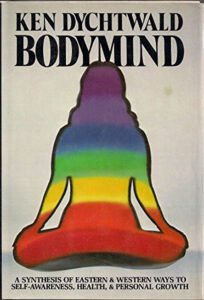
A TOUCHSTONE REVIEW:
Bodymind *
by Ken Dychtwald
Tarcher Putman; updated edition (1986)
* For this review, I have mined information on the history and influence of this book from Kurt Leland’s Rainbow Body: A History of the Western Chakra System from Blavatsky to Brennan (2016).
The Book
The original title of this book – Bodymind: A Synthesis of Eastern and Western Approaches to Self-Awareness, Health, and Personal Growth – bespeaks the general tendency of the 1970s to synthesize the popular Hindu yogic concept of chakras and the concepts of prana (vital energy), tantra, and the nadi (subtle energy channels) with popular Western therapeutic practices like reiki and Chinese acupuncture to improve personal self-esteem, mental health and to unblock energy flow throughout the body.
“Bodymind” was the title of the first “open encounter” workshop which the author, Ken Dychtwald, attended at the Esalen Institute at Big Sur, California. The book opens with a description of the author’s experience during this first amazing therapy session, when the therapist “read” with uncanny accuracy what was “held” in the posture of the author’s naked body.
In this book, the author, a 27-year-old with a PhD in gerontology at the time of writing, recalls in a friendly conversational tone experiences he had like this during his younger days in therapy sessions and encounter groups. The author portrays his own journey of self-analysis, body region by body region, as a model for his readers to follow to discover themselves. More than a memoir, Bodymind is one of the most revealing records of the therapeutic theory and practice going on at Esalen in the early 1970s.
Dychtwald’s Chakra System
The tantric traditions of the East consider the psychic body (the subtle body or energy body) to be the intermediary between the individual person and the godhead. In terms of the Esalen human potential movement the bodymind is the intermediary. Dychtwald and his chakra system represents this movement. He lists the qualities to be achieved at each level of the chakras in order to realize full liberation from the social conditioning that prevents full use of and enjoyment of bodymind.
In Dychtwald’s system, the notion of a continuum of human potential is thoroughly psychologized. The notion implies a process in which people must disentangle themselves from the needs of the first three lower chakras by powers of mind in order to achieve a more developed sense of self. By “powers of mind” Dychtwald implies both cognition (Aurobindo’s thinking mind) and intuition or psychic abilities (Aurobindo’s higher mind). He even used the term “third eye chakra” to describe the sixth chakra in his system.
Dychtwald for the first time brought into print the spectrum of rainbow colors into the list of chakra qualities commonly in use today. Kurt Leland, in his book Rainbow Body, tells how.
The dust jacket of the first edition of Bodymind, published in June 1977, pictures a human silhouette in meditation pose with the chakras represented by colored bands in rainbow order.
The chakras are more specifically located in the body throughout the book in black-and-white illustrations based on this form. For Dychtwald, the location of the chakras “suggests a path along which an individual might travel on his personal road to optimal bodymind health and a full realization of his human potential.” His use of this metaphor implies that the chakras are where the body and mind meet. This implication marked a change in Esalen’s central metaphor of the continuum of human potential.
To promote his book Bodymind, Dychtwald contributed an article to the July/August 1977 issue of Yoga Journal: “Bodymind and the Evolution to Cosmic Consciousness.”
In this article, Dychtwald states that “each chakra corresponds to a particular color vibration with the lowest chakra projecting the color red and each ascending chakra projecting the next color of the rainbow: orange, yellow, green, blue, indigo, and violet for the seventh chakra.” Thus he made the first statement in print that assigned the rainbow spectrum colors to the chakras that is now ubiquitous.
Following this statement, Dychtwald lists the chakra qualities given in his book and gives a resume of chakra functions, adding the phrase “expanded mental powers” to his description of the sixth chakra. He also says that the seventh chakra “corresponds to the highest level of human development.” He lists several names for this state: “enlightenment, samadhi, nirvana, God consciousness, and cosmic consciousness.” And so, by means of his book Bodymind and this Yoga Journal article, the Esalen list of chakra qualities and the chromotherapists’ list of rainbow colors came together for the first time.
This Western chakra system developed for the purpose of well-being into the most common version of the major chakras in use in the West today. It retained the Sanskrit names, located them on the physical body from the base of the spine to the top of the head, and established the English names of their qualities:
7. Crown Chakra (Sahasrara) – wisdom / self-realization / cosmic consciousness
6. Brow Chakra or Third Eye Chakra (Ajna) – self-reflection / self-awareness
5. Throat Chakra (Vishuddha) – communication
4. Heart Chakra (Anahata) – love
3. Solar Plexus Chakra or Navel Chakra (Manipura) – power
2. Sacral Chakra (Svadhisthana) – sexuality
1. Root Chakra (Muladhara) – survival
Tibetan Buddhism began to grow more popular among Americans, Dychtwald’s version of the chakra system gained ground while the other systems gradually disappeared from most New Age presentations of the chakras and became extinct. Dychtwald’s pairing of the chromotherapists’ rainbow colors with Esalen’s chakra qualities began to spread into alternative healing modalities beyond those taught at Esalen to relieve energy blockage and achieve activation of the pineal gland, which Dychtwald recognized to be the master gland of the endocrine system that controls and stimulates all other glands.
Dychtwald no doubt hoped that his book would inject something transformative into American culture. But that “something” was not the chakra system itself. He doesn’t ask or answer questions like, Are chakras real? What is the number of chakras? Is there scientific evidence for the existence of chakras? He used the concept of chakras and the seven-chakra system primarily to organize the structure of his book. But in doing so, Dychtwald’s book provides a gift to our understanding of how intimately and intricately interwoven the human mind is with the human body. And this understanding suggests the image of still higher and more intricate states of “bodymind,” states of being which the author himself was in search of.
Going Further
Man is not solely a physical being. Man also has a psychic being and a spiritual being. But their attributes, the psychic and spiritual faculties, are not usually experienced to any practical degree by the average individual who does not follow a system of spiritual development.