
A TOUCHSTONE REVIEW:
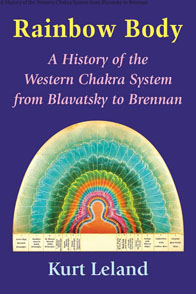
Rainbow Body: A History of the Western Chakra System from Blavatsky to Brennan
by Kurt Leland
Ibis Press (2016)
The Book
Evolution of Chakra Systems
The modern Western chakra system did not originate in ancient India as commonly believed, but evolved through a series of reinterpretations that culminated in what is now often called the “rainbow body” model. This book explores the “rainbow body” as a historical and conceptual framework for understanding the evolution of the Western chakra system — not the Tibetan Buddhist concept.
Kurt Leland’s history of the Western chakra system covers the period from the 1880s to the 1990s. This is over one hundred years of development, evolution, and cross-sharing between East and West. And much of the cross-sharing was done without acknowledgment. As a step-by-step account of the development of the current Western chakra system out of the classical Eastern chakra system, this book is gold. I can’t imagine the story told in finer fashion. It is as objective as can be.
Before the story begins, Leland provides a clear chronological summary of the development of the chakra system in the East from 1500 BCE to 1577 CE. His abundant notes point out controversies in the dating of ancient and medieval texts. And they identify the precise location in these texts of the passages that discuss the chakras directly.
Theosophical Transformation
For the Theosophical Society in America, Leland tells the story of how the Western chakra system developed from its roots in Indian Tantra, through Helene Blavatsky to Charles Leadbeater, Rudolph Steiner to Alice Bailey, Carl Jung to Joseph Campbell, Ramakrishna to Sri Aurobindo, and the Esalen Institute to Shirley MacLaine and Barbara Brennan.
Along the way, he addresses the differences among chakra systems. And he lays out the names, colors, locations, qualities, and other associations assigned to them in the various systems. Leland does this to show how the Western chakra system developed for the purpose of well-being and then came together around 1977 into the most common version of the major chakras in use in the West today:
7. Crown Chakra (Sahasrara) – wisdom / self-realization / cosmic consciousness
6. Brow Chakra or Third Eye Chakra (Ajna) – self-reflection / self-awareness
5. Throat Chakra (Vishuddha) – communication
4. Heart Chakra (Anahata) – love
3. Solar Plexus Chakra or Navel Chakra (Manipura) – power
2. Sacral Chakra (Svadhisthana) – sexuality
1. Root Chakra (Muladhara) – survival
The narrative progresses through six parts.
Part 1 deals with the early evolution of the Hindu chakra system in India.
Part 2 (1879-1891) shows the key role Madame Blavatsky and the Theosophical Society played in transmitting Hinduism’s concept of chakras as centers of vital energy to the West. It was a process that radically altered those teachings. The result was the list of anatomical correspondences from the base of the spine to the top of the head that most New Age books now follow.
One entire chapter elucidates and expands upon Blavatsky’s only written instructions on the chakras. Another does the same for Blavatsky’s matrix of correspondences for Kundalini practice. This is important to Leland’s history. It is from this matrix that the Western seven chakra system evolved.
Part 3 (1890s-1920s) details the contributions made to the Western chakra system during the first epoch of its development. During this period, Indian yogis presented tantric teachings on Kundalini and the chakras for the first time in modern times. Then members of the Theosophical Society interpreted them. Clairvoyant investigations and translations of Sanskrit texts followed. The first of these translations were made by John Woodroffe in The Serpent Power, an exposition of yogic tantra as it relates to the chakras and the three primary energy channels (nadis) that conduct subtle energy or vital energy (prana) throughout the subtle body.
Introduction of Rainbow Colors
Part 4 (1920s-1950s) explains how the rainbow colors, the nervous system, and the endocrine glands, especially the pineal gland and the pituitary gland, came to be associated with the Western chakra system. It was a creative time. Topics of the Eastern chakra system commingled with Western scientific knowledge of the endocrine system and nervous system. And practitioners of color therapy in the United States and England assigned the spectrum of rainbow colors to the main chakras from the lower chakras to higher chakras.
Esalen and the Western Chakra Model
Part 5 (1930s-1970s) presents the contributions made toward the evolution of the Western chakra system by Western and Vedic scholars. Leland’s focus during this forty-year period is on the teachers who gathered in the Esalen Institute’s human potential movement and their concerns with the mind and body and energy flow and blockage.
A lot was going on during this time. News of Kundalini and the chakras began to spread through the intellectual circles of Europe. The 1919 publication of John Woodroffe’s Serpent Power catalyzed this spread. Carl Jung began to discuss this book and Kundalini yoga in the 1930s. Joseph Campbell met with Jung in the 1950s. He consolidated information from Jung and the teachings of Ramakrishna from the 1970s through 2000.
Knowledge of Aurobindo’s chakra system came to the founders of Esalen in the 1950s. And in the 1970s, the five-chakra system developed into the seven-chakra system popular today. After that, Esalen established the workshop format that has been the primary means of disseminating information about the human body, energy healing, and the Western chakra system ever since.
Part 6 (1980s-present) presents a number of competing systems and the controversies that arose. Leland also makes an account of the attempts made to resolve these controversies.
The Rainbow Body Concept
In the 1980s, Ken Dychtwald’s version of the chakra system gained ground. Other New Age systems went extinct. Dychtwald’s pairing of the chromotherapist’s rainbow colors with Esalen’s chakra qualities spread into alternative healing modalities during this period. Chakra “balancing” became a core practice. So did “unblocking” chakras. Controversies and disagreements abounded.
The therapist Anodea Judith was the first to codify the new Western chakra system. She attempted to resolve the great chakra controversy with her book Wheels of Life (1987). A manual for self-development and chakra activation, it linked the evolution of the chakras with yoga postures. The synthesizing tendency of the 1980s also produced the psychological approach of the healer Barbara Brennan. For Leland, the correlations Brennan made in Hands of Light (1988) represent the final stage in the evolution of the Western chakra system. They codify its esoteric dimension.
Leland is primarily a researcher of esoteric history. But he is also an investigator of the possibilities of consciousness. Thus Leland closes the book with his own speculations on the final stage in the development of the Western chakra system. He sees it could be “the codifying of esoteric teachings on chakras, subtle bodies, and planes and their use in astral projection.” By these means Leland believes it is possible to realize spiritual consciousness.
Only here, on this point, does the book require amendment.
Going Further
There is another kind of final stage. It is one that codifies the teachings of the ancient solar Orders and provides the means of achieving true spiritual Consciousness. Allow me to explain:
Humans are photoelectric complexes of three distinct entities or bodies. The eight plexuses of the physical body are extensions of the eight psychic energy centers. These eight minor force centers of the psychic body (the chakras) issue in pairs out of the four major force centers of the spiritual body. These four solar force centers are the catalysts through which higher energy frequencies flow.
The three energy bodies are interrelated. The energy of each permeates the others. And light and color can modify the psycho-physical color bodies and their related force centers. Absorption of solar energy in the proper manner activates the flow of energy among the eight plexuses of the physical body and the eight force centers of the psychic body. But the goal is to go beyond the duality of the physical and psychic bodies. The ultimate goal is to develop the immortal Light body and a state of true spiritual Consciousness.
This is what the System of Cosolargy has to offer.