
A TOUCHSTONE REVIEW:
Wheels of Light: Chakras, Auras, and the Healing Energy of the Body * **
by Rosalyn L. Bruyere
Atria (1989, 1994, 2009)
* For this review, I have mined information on the history and influence of this book from Kurt Leland’s Rainbow Body: A History of the Western Chakra System from Blavatsky to Brennan (2016).
** Rosalyn Bruyere did not make herself available for comment, although it was my hope that she would provide additional information and corrections to this review.
The Author: Rosalyn L. Bruyere (1946 – )
Website: https://www.rosalynlbruyere.org

Rosalyn Bruyere 2019
When Rosalyn Bruyere was very young, her great-grandmother taught her to see the lights or auras around plants. Her great-grandmother’s psychic abilities alarmed her family and, when Bruyere was six, they sent her great-grandmother to receive electroshock treatments. When she returned from these treatments, Bruyere saw that she had lost her abilities. From then on, Bruyere let on to no one that she too had psychic abilities in order to avoid being treated the same way.
Then, when she was in her twenties, her own children began to speak about seeing “colored fuzz” around people. Their ability to see auras stimulated her own abilities and interest once again. She sought out teachers and was taught rudimentary healing techniques, and she gained a reputation as an aura reader. But she had no intention of becoming a healer until the people she “treated” felt better and she discovered that a healer is what she had become.
In time, Bruyere came to understand that health of mind and body means to become “full of light.” She began to study. The more she studied, the more she found a variety of cultural references to the chakra system.
She discovered that the aura and the meaning of the auric colors often differed from culture to culture. These observations led her to ask whether the practices of different religions change the auric colors. Her explorations led her to consider that if an entire culture’s thought process was dominated by a particular chakra color, that culture would tend to see reality through the “eyes” or particular viewpoint of that dominant chakra.
To Bruyere, it seemed that Native Americans are the only people who have a natural relationship with the chakra system that has not been dogmatized. And since that realization, she has been greatly influenced by the traditions and ways of these peoples.
She also came to understand that in antiquity, before science and religion were divided into separate, antagonistic camps, the chakras were an integrated part of daily life. She learned that even when the ancient civilizations of the Egyptians, Chinese, Brahmans, Greeks, and Native Americans were conquered or destroyed, sacred priesthoods preserved knowledge of these mysteries and what H. P. Blavatsky called the “universally diffused religion of the ancient and prehistoric world.”
In the 1970s, Bruyere was introduced to UCLA psychologist Dr. Valerie Hunt , who was conducting research on the effects of rolfing on the human body. Dr. Hunt asked her to participate in the project to help measure the effects with her ability to perceive and interpret auric phenomenon. Trained as an engineer, Bruyere was instrumental in the eight-year research project.
Bruyere’s role in the research was to perceive the energetic effect of Rolfing on the chakras as a clairvoyant while scientific instruments recorded information on fluctuations of electrical charges in the skin in areas where the chakras were located. Readings of the electromagnetic field were taken before, during, and after the Rolfing process specified by Ida Rolf’s program of Structural Integration. The findings of this project seemed to provide scientific evidence for the existence of the human aura and measured it scientifically for the first time.
In l975 Bruyere founded the Healing Light Center Church in Glendale, California and became its pastor, so that she could lay hands on people without risk of being charged with practicing medicine without a license. She set up a clinic and school in the basement of the Maryland Hotel in Glendale, where she taught a generation of healers who now practice across the country, including Barbara Brennan, who founded the world’s largest hands-on healing school in New York. As director of the church and the school, Bruyere has committed her life to the teaching of sacred ancient healing disciplines to ordained ministers, most of whom are graduates of her four-year training program.
By the time Rosalyn Bruyere wrote Wheels of Light in 1989, she had already served twenty years as a healer and teacher.
Bruyere’s ability to see patterns of disease and behavior in detail and to energetically transform tissue at a cellular level brought her worldwide attention and a reputation as one of the nation’s most successful healers. Today she lives in Sierra Madre, California and remains an internationally acclaimed healer, clairvoyant, and medicine woman.
The Book
Link to searchable 1994 edition of Wheels of Light
Chakra Healing: Exercises and Meditations to Use and Balance Chakra Energies for Greater Health,
Audio Renaissance (1990) is the CD companion piece to Wheels of Light.
In this 60-minute audio cassette, the Rev. Rosalyn L. Bruyere offers not only a clear description of the chakras and the auric field, but also guides listeners through exercises and meditations for sensing and interpreting the flow of chakra energies within themselves.
Wheels of Light, A Study of the Chakras provides four take-aways that readers are not likely to find elsewhere, even today:
First, the recognition that chakras are universal archetypes found in cultures throughout time and place.
Second, an extensive and expansive view of what sexual orgasm is, how it works, and what purpose its serves in overall well-being based on the dynamics of the chakras of the human energy body. Arguing from the nature of the human energy field, she also makes a perfectly rational argument why sexual intercourse should not be casual but a sacred activity.
Third, a complete description of the Rolf Study experiment in 1976 that first showed the human energy field exists and that a clairvoyant’s perceptions coincided with recorded, measured electronic data (an experiment in which the author took part).
Fourth, the first description of chelation, the therapy the author invented to clean, purify, and clear blockages in the chakras.
The book is valuable for bridging of ancient and modern healing arts because Bruyere sees the chakra system as part of the ancient and lost mysteries. Early on in Part I, Bruyere sets about unraveling some of the sacred mysteries of the ancients, beginning with the Native American Hopi and the Egyptian priest-scribe generally known in myth and legend by his Greek name Hermes, who is credited with defining for the first time the elementary nature of the chakra system. The discussion continues into Part II.
Rosalyn Bruyere Chakra System Explained
Rosalyn Bruyere presents the chakra system as a set of energy centers within the human energy field. In her work, chakras are part of a larger energetic structure that supports healing processes, perception, and the organization of the subtle body.
The Bruyere chakra system emphasizes the relationship between chakras and the surrounding energy field. The chakras function as dynamic interfaces through which energy is processed and distributed throughout the system.
The historian of the Western chakra system Kurt Leland notes that Bruyere’s vision of the chakra system differs on several counts with the now-ubiquitous Western system:
-
What is an Aura?
This energy field, she believes, is directly related to mind – to thought and memory, which science now postulates exist throughout the body. “If the aura is anything,” she says, “it is the mind: not the mind in the sense of the intellect but in the sense of the greater mind, the electromagnetic field which surrounds and generates the body.” Bruyere describes the aura as a luminous emanation “that extends beyond the body to interact with our external environment … generated by the spinning of smaller vortices of energy located within the body.”
-
Bruyere’s Chakra System
Bruyere’s experience indicates that each chakra has four discernible characteriestic that functionally affect the aura: color, size and shape, rotation or spin, and intensity. Intensity is a function of how open or blocked a chakra is.
Bruyere posits that each chakra also has its own particular point of view and interacts with the others. However, Bruyere says, all the chakras are essentially identical:
Our research [in the Rolf Study] showed them to be the same size. Each is basically the same shape. Most importantly, each chakra has, if not an essence of all the other chakras, at least a matrix or network that allows for another chakra to exist…. Simply stated, each chakra is both unique and potentially interactive with each other chakra, having both a specific viewpoint and the structure for a distinctly different one.
Each of us exists through an interaction of many chakras. By focusing our attention on one chakra center or another, we limit ourselves to a single viewpoint of the world. Nothing really ever happens in a chakra. A chakra is only a point of origin. It is the effect of energy moving through a chakra which is important. Where a flow of energy … encounters the energy of a spinning chakra, it is pulled upward. It is this dynamic that moves energy from chakra to chakra…. As it spins, each chakra—a unique electromagnetic wave generator—creates a particular frequency. The frequency generated appears as a color that is unique only to that chakra…. When the system is functioning appropriately, there is a specific mathematical relationship between the frequencies of the chakras: the frequency of each chakra increases as we move up the chakra system. Not only was this found to be so in the lab, but this phenomenon is discussed in the Veda and in other ancient texts, where it is referred to as “the multiple.”
The seven chakras “are who and what we are, what we feel and how we think and change. They are how we express ourselves and how we create. Although we as Westerners have no cognitive awareness of its energies, the chakra system is precisely the means by which we gain awareness. It is how we experience life, how we perceive reality, and how we relate to self, others, and the world. It is life itself.”
Bruyere describes concisely how the chakras interact to produce the auric field and to produce changes in the field:
Our auric or electromagnetic field is generated by the spinning of the chakras…. As it spins, each chakra produces its own eletromagnetic field. This field then combines with fields generated by other chakras to produce the auric field. An individual’s auric field is manifested via a combination of energies from three chakras. Generally these are the first, third and fifth chakras, empowering the physical, intellectual, and etheric bodies. It is a combination of these three chakras that produces the primary auric field (the inner shell of the aura), which can be physically felt by the hand as it is passed over another’s body. If one is sensitive enough, the secondary auric field (the outer shell) can also be felt. This secondary aura is produced from the interaction of all seven chakras.
The spinning of the individual chakras creates energy, the frequency of which determines the color of a particular chakra. The amount or intensity of energy produced by a particular chakra or group of chakras determines the color that dominates the auric field.
The auric field colors – red, orange, yellow, green, blue, violet, and white – “are very specifically related to the chakras.”
Her ideas on the colors of the chakras express her theory of chakra harmonics:
The auric field actually exists in different layers of color sometimes referred to as harmonics. In other words, for people who can see the aura, it appears as a pattern of colors near the body and then another pattern of colors farther away from the body, and so on…. The color in each chakra likewise is composed of varying frequency bands within the range of that same color.
Chakra harmonics, Bruyere says, works by analogy like musical harmonics or sympathetic vibration:
As the frequency or harmonics or vibration of energy our body channels gets slower we become more physical; as the frequency of this energy gets faster we become more esoteric, less physical. There is a definite continuum from low to high frequency, and in the esoteric world we are trying to channel and maintain finer and higher frequencies (vibrations).
The table below presents a basic template of Bruyere’s chakra system.
LOCATION | BRUYERE COLOR | BRUYERE SUBTLE BODY | SANSKRIT NAME |
Crown Chakra | White | Ketheric | Sahasrara |
Forehead or Third Eye Chakra | Purple | Celestial | Ajna |
Throat Chakra | Blue | Etheric | Vishuddha |
Heart Chakra | Green | Astral | Anahata |
Solar Plexus Chakra | Yellow | Mental | Manipura |
Sacral Chakra | Orange | Emotional | Svadhisthana |
Base or Root Chakra | Red | Physical | Muladhara |
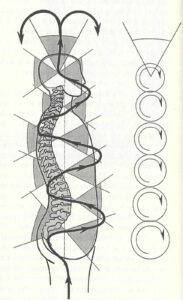
Figure 3.5 Location of the Chakras in Relation to the Backbone and the Front of the Body, Wheels of Light, p. 68
The first chakra faces downward and the seventh or crown chakra faces upward, just as Charles Leadbeater and Barbara Brennan describe.
The first three chakras are often called the “lower chakras” or the “lower centers,” the fourth chakra referred to as the ‘transitional’ or the ‘transformational center,’ and the upper three chakras called the “upper chakras” or the “upper centers.”
Bruyere also recognizes “two higher chakras that exist outside the body— the Atman and the Brahman—there are actually nine chakras.”
-
The Flow of Vital Energy Up the Chakras
When a stimulus comes into the body … the heart chakra is typically the place where this flow of energy [life force or prana] is absorbed or drained from the field. However, if energy is not drained or absorbed when it enters the heart center, it is then free to continue out the fifth chakra, in the sixth and finally out the seventh or crown chakra. That process of in and out, in and out, in and out becomes important. The source of the energy that moves throughout the body is the earth’s magnetic field, acted upon and modified by the electrical field of that body. … The auric field has a movement that tends to make energy ‘sweeps.’ which are usually three or four inches apart…. This serpentine dance of the auric field through the body and chakras produces a very complex interaction with the body’s neurological and physiological systems.
-
Direction of Spin of the Chakras
When energy enters the body it moves upward from one chakra to the next. In some cases, however, this energy can be lost before traversing all the chakras. Generally a healthy, functioning chakra will spin or turn in a clockwise direction (when we are viewing the front of a person), so that the energy will be drawn upwards to the next chakra. When the energy encounters a chakra that is spinning counterclockwise, it will be dissipated or drained from the system. Sometimes a chakra will not seem to be spinning at all. This is often indicative of a weak chakra, which blocks energy flow…. Often, if a person is tired, the heart chakra will become elliptical. If there is something wrong energetically, the chakra will also show as an ellipse. If, however there is serious damage or pathology in any organ, the chakra associated with that organ will spin backwards or counter-clockwise. Thus, the direction of rotation, shape, and diameter of a chakra indicates the state of its energy and the health of its corresponding or adjacent physical organs. Some healers actually see this movement in much the same way as they see an aura; others feel it or sense it tactilely or empathetically within their own bodies.
-
Interaction Between Chakras
The chakra system represents not just one level of reality, but several, Bruyere informs us: “The interaction of chakras is the entire process. All must function together in balance in order for each and every person to function as a complete sentient being.”
-
The Chakras and Healing
At present, health in our country is defined as lack of disease. That is really not a reasonable definition for health. Health means ‘full of light.’ Less than ‘full of light’ might be termed ‘disease.’ However, if we do not have an instrument to measure ‘full of light,’ we are left with the model of ‘normal health’ that is deficient in many respects. The fact of the matter is we really have no concept of what ‘normal’ is for the body. Therefore, it might behoove us all to change our view of health to include much broader terms.
Going Further
Like most clairvoyant healers, Rosalyn Bruyere merely touches on the notion of the divine and does not discuss spiritual energy in her chakra system to any great depth. But her statement that health means “full of light” holds true in the spiritual realm as well as the physical.
Conscious spiritual being – that is to say, the soul – is the prototype of humankind. The “psychogenetic” person is merely a copy of the soul in physical form under the influence of physical laws.
In the ancient philosophies and religions of the world, it was taught that man was made in the Image of God as a Light body rather than as a physical body and that Light was the carrier of the divine Word or Logos. Though this Light was invisible and generated by God from spiritual realms, it was nevertheless related to the visible light of the physical universe. And it seems that the ancient philosophers of the mystical schools and the priests of the old world religions were able to contact the supreme creative force in the universe through a process of spiritual regeneration.
Most people today are not experiencing this contact. But it can be made. The process begins on the physiological and the psychological levels. The glands of the endocrine system are energized and begin to supply needed secretions into the blood stream; optical ganglia and nerve centers are stimulated; new retinal receptors emerge; and the pineal gland emerges like a flower and becomes the elixir of life that nourishes the physical body. Latent genetic factors are generated in the process, and, in time, latent spiritual faculties, wilted and all but atrophied, come to life again. The sun – and the proper application of its higher energies according to a sacred System – is the key.
The process involves linking the mundane soul with the pre-existent spiritual soul. The Cosolargy Academy presents the necessary techniques.
The System of Cosolargy is available to all individuals who sincerely wish to participate in their divine heritage by preparing them on all levels of their being to develop the non-physical Light body and to achieve full spiritual Consciousness.